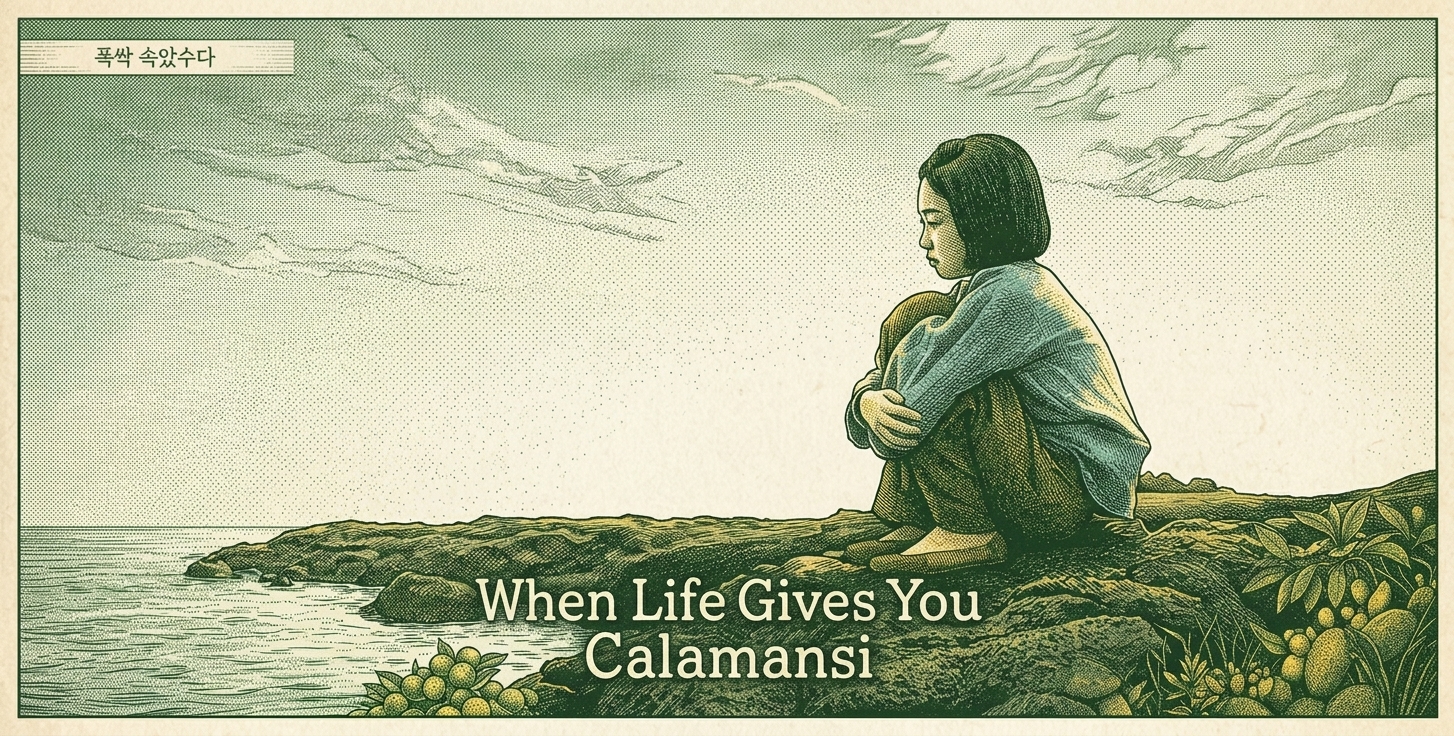
The Netflix series When Life Gives You Tangerines hits hard. I cannot shake the calm rush of memories it set off. The show is a Matryoshka doll. Open one layer, and a smaller one waits inside—a gift that keeps opening. You uncover your own life one layer at a time, like peeling fruit.
In Gwan Sik, the hardworking fisherman of Jeju, I see my father. He married Oh Aesun, the daughter of a haenyeodiver. Modest origins, shaped by their era. My parents were no different.
Whether they were each other’s first love, I do not know. But they were inseparable. Misery set in whenever they were apart.
Their romance lacked the dramatic misery of screenplays, though it had its moments. To see my mother, my father used to scale the balcony of her parents' home. It took athletic skill. Or hormones. Or love, for lack of a better word.
The Jeju couple ran away, took a ferry to Busan, and were driven back by circumstance. It took time, but Aesun eventually got her dream wedding. My parents took a quicker route. They eloped to Magdalena—six miles southeast of our hometown—for a secret ceremony, then held a second, official church wedding two years later for the family.
Like their eldest child, Geum Myeong, I arrived when life was smooth and comfortable. I was never short on affection. Growing up in my maternal ancestral home, I had several mothers: my grandmother, my Tiang Bebe, my mother. I had several fathers including Tatay Pedring, my lolo. Cousins and playmates were everywhere. I was not lonely.
My parents' generation had it rough. They inherited a plain, unyielding rule: take care of everyone. Leave no one behind. Everyone is your responsibility.
Geum Myeong felt that weight. So did I. As a child, I kept house and minded my younger siblings while my parents worked. "Take care of them," I was told constantly. It was a heavy charge for a young mind. It left a mark. It bred a small rebel. Yet responsibility is a hard habit to break. When I take something on, I finish it.
When school began, my father set the bar high. An 85 was not enough. "Do better," he said. The honor roll was not enough. "Be Number One."
Geum Myeong was naturally bright. I was not. I had to work at it. But both sets of parents valued education. She went to a fine university. So did I, which meant packing my bags and leaving home.
There is a scene where Geum Myeong vents her frustration over feeling guilty. She asks herself if she truly cares, or if she acts merely out of obligation.
I have asked myself the same thing for years. Relatives rarely miss a chance to remind you of your duty.
I feel guilty for feeling guilty. How could I not? My father, full of pride, framed every certificate I ever earned. He covered an entire living room wall, with my university diploma right in the center. Such devotion.
That parchment was a record of my hard work. To my father, it was something else: years of pinched pennies and swallowed pride to borrow tuition. In the 1990s, a full course load cost about six thousand pesos.
During my final semester, my father told his brother I might graduate with honors. I had made no such promise. But my uncle, a local police officer, told everyone in town. I wanted to crawl into a shell. The weight of their expectations was terrifying. I did graduate with honors, thank goodness. It saved us all from having to retract the news.
Deep down, it was endearing. I brought honor to the name. I made them proud.
The pressure on an honor student is real. Expectations build quickly. Early in my career, I felt like a monumental failure. I broke my father’s heart more than once. I fell short of the promise.
Yet hope is stubborn. There is still time to make amends. My story is full of pauses and punctuation, but like Aesun's, the final sentence has not yet found its period.
No responses yet. Tell me what this brought back for you.