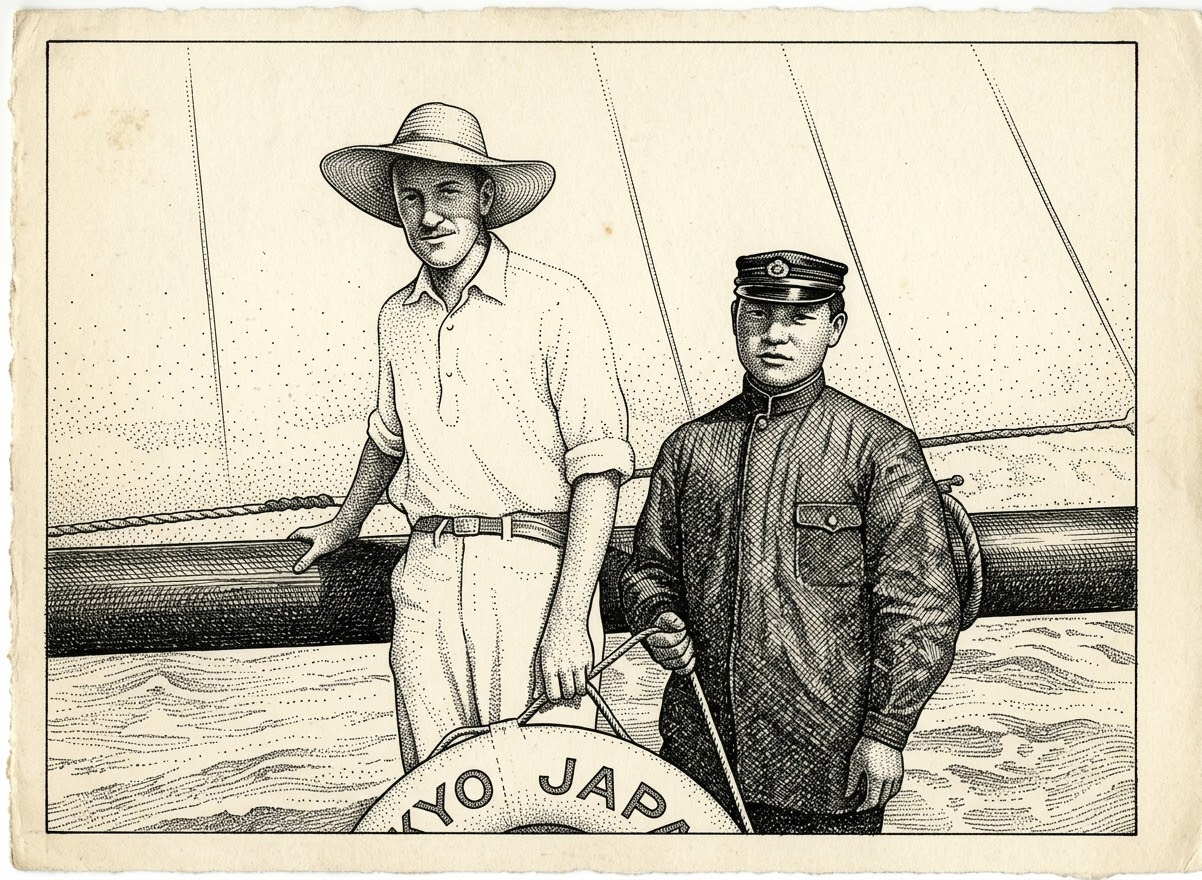
Hans Hornbostel had a dry, understated way of remembering his travels. Long before the war came to the Pacific, he left Guam for the Philippines, where he took a job as advertising and circulation manager for the Philippine Magazine. It was during those years that he wrote his series Rota Days. Reading his words today brings the islands right back.
For those of us who came later, the trip between Saipan and Rota meant a quick jump on a small twin-engine plane. You would check in, board a flight operated by Freedom Air or Star Marianas—or later on, when Tony Pellegrino’s Arctic Circle Air introduced its newer service to the route—and watch the turquoise reefs recede beneath the wings. Within forty-five minutes, you were on the tarmac at Rota, barely having had time to settle into your seat.
Reading Hornbostel’s story, however, makes you realize just what an ordeal that same short crossing used to be by sea.
The 90-foot Japanese schooner was less a ship and more a floating hazard. There were no passenger cabins; everyone, except the captain and crew, simply sat on the open deck alongside the cargo.
What should have been a brief hundred-mile run became two and a half days of continuous tacking against a hard headwind. With every turn, the ship lurched. Her heavy boom swung wild across the deck, forcing everyone to duck for cover. There were no modern conveniences like smartphones or tablets to distract them, not even wireless radios or lifeboats to offer comfort. Every passenger was on edge. They crowded the scuppers in pure misery: paralyzed by seasickness and the alarming possibility of being tossed over the side.
The height of the drama arrived on the second day. An elderly woman approached Hornbostel to inform him, with great urgency, that her daughter Estrella was going into labor.
Hornbostel, whose background was in collecting ancient artifacts and mapping stone monuments, was abruptly pressed into service as a shipboard midwife. The captain offered a clean blanket, a pair of scissors, and a length of fishing line. Hornbostel brought out his personal supply of whiskey, using it to comfort the mother and sterilize the captain's scissors.
As Estrella’s mother handled the delivery, Hornbostel held back the crowd. When the baby arrived safely, the mother immediately began praying that the child would live long enough to reach Rota for a proper baptism. The surrounding passengers, taking the cue and fearing for their own souls on the stormy sea, quickly joined in the prayers.
The small schooner eventually made its way past the booming breakers of the outer reef and glided into the serene Rota harbor. As the anchor dropped, warm smells of morning woodsmoke reached them on board, and everyone breathed a sigh of relief. They were finally home. The ordeal was over. And for Hornbostel, it was an adventure for the books—one of the finest anecdotes from this period ever told.
No responses yet. Tell me what this brought back for you.