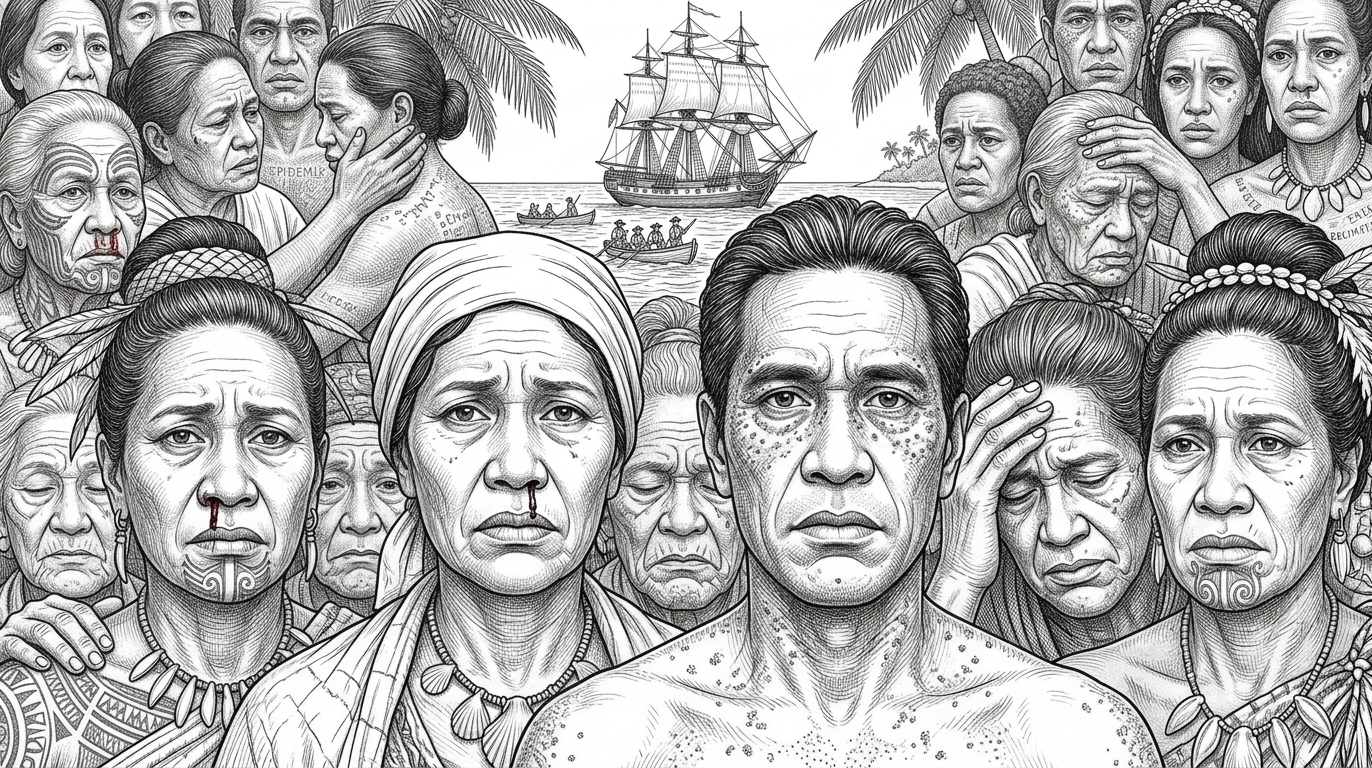
There is an eerie, understated horror in the meeting of two worlds.
I was watching a National Geographic segment recently on Disney Plus that revisited how European ships brought biological warfare to South America—not through gunpowder, but through invisible, highly contagious diseases that wiped out thousands who had never encountered them before. It immediately brought me back to the Pacific, where that exact same tragedy played out across the islands.
For centuries, the vast ocean was a sanctuary. Insularity was bliss to Pacific islanders up until Westerners arrived with their ship-borne diseases. As Western whalers, traders, and mission ships began crowding into quiet bays, that centuries-old island bubble burst without warning.
The historical accounts documented by Jesuit Fr. Francis X. Hezel and Australian scholar Dr. Dirk Spennemann paint a chilling picture. In 1854, American whaleship Delta dropped anchor off Pohnpei carrying smallpox, nearly 4,000 people—roughly 40 percent of the island—were dead within months. On Kosrae, a casual visit turned out to be deadly, living in its wake a depopulation of about 90 percent. From 3,000, population went down to 300. It was the same story on Guam: the 1856 small pox outbreak wiped out a third of the island. Talk about an unwanted pasalubong!
It’s a terrifying thing to realize that the islanders' welcoming spirit would ultimately lead to their undoing. Fr. Hezel offered a staggering statistic: before Western contact, the Chamorro population stood at roughly 40,000. Tragically, they were not conquered primarily by muskets or swords, but by introduced diseases that winnowed their numbers down to barely 4,000 by the early 1700s. Even during the ensuing three decades of the Spanish-Chamorro Wars, the casualties from actual violence were a tiny fraction compared to the silent ravages of epidemic sickness.
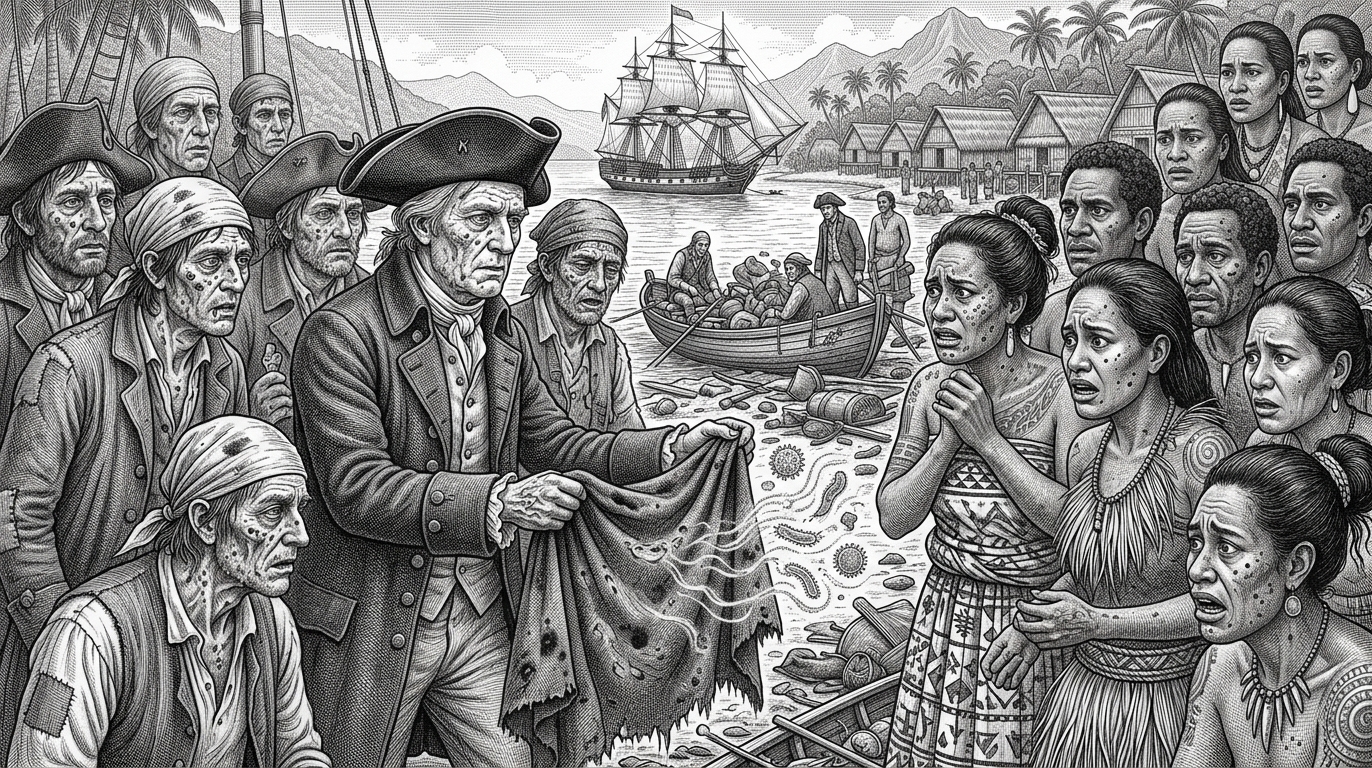
As modern epidemiological research by G.D. Shanks and his team points out, these islanders didn't perish because they were weak or genetically unlucky; they died because they were simply too isolated for too long. When a virgin-soil epidemic hits an island, it doesn't take turns. It strikes the lolo, the lola, the working parents, and the kids all at once. With every generation bedridden simultaneously, nobody is left to fetch water, cook a pot of lugaw, or offer basic care. The whole social fabric just unravels.
That vulnerability still echoes. When COVID-19 arrived, Pacific nations skipped the hand-wringing and shut their borders faster than a sari-sari store in a typhoon. Yet as global travel eventually breached those defenses, the old traps sprung open again. From the home islands to diaspora enclaves in Queens, Pacific Islander families suffered disproportionate losses—their multi-generational homes, frontline roles, and thin medical safety nets mirroring the exact vulnerabilities of the 1800s.
The islanders offered hospitality; the ships brought catastrophic exposure. Long before treaties were signed, the fate of the Pacific was decided not by military might, but by the invisible passengers that stepped ashore first.
No responses yet. Tell me what this brought back for you.