Memory is an unreliable house guest. The further back something happened, the more it sounds like a story about somebody else, and I sometimes can't say whether a moment really took place or whether I only pictured it so often that it moved in and stayed. The good days slip out without saying goodbye. The embarrassing ones never leave at all, and they can still make me wince years later.
One of the embarrassing ones goes back to high school, when I began asking where we came from. That was how I found out our last name isn't ours.
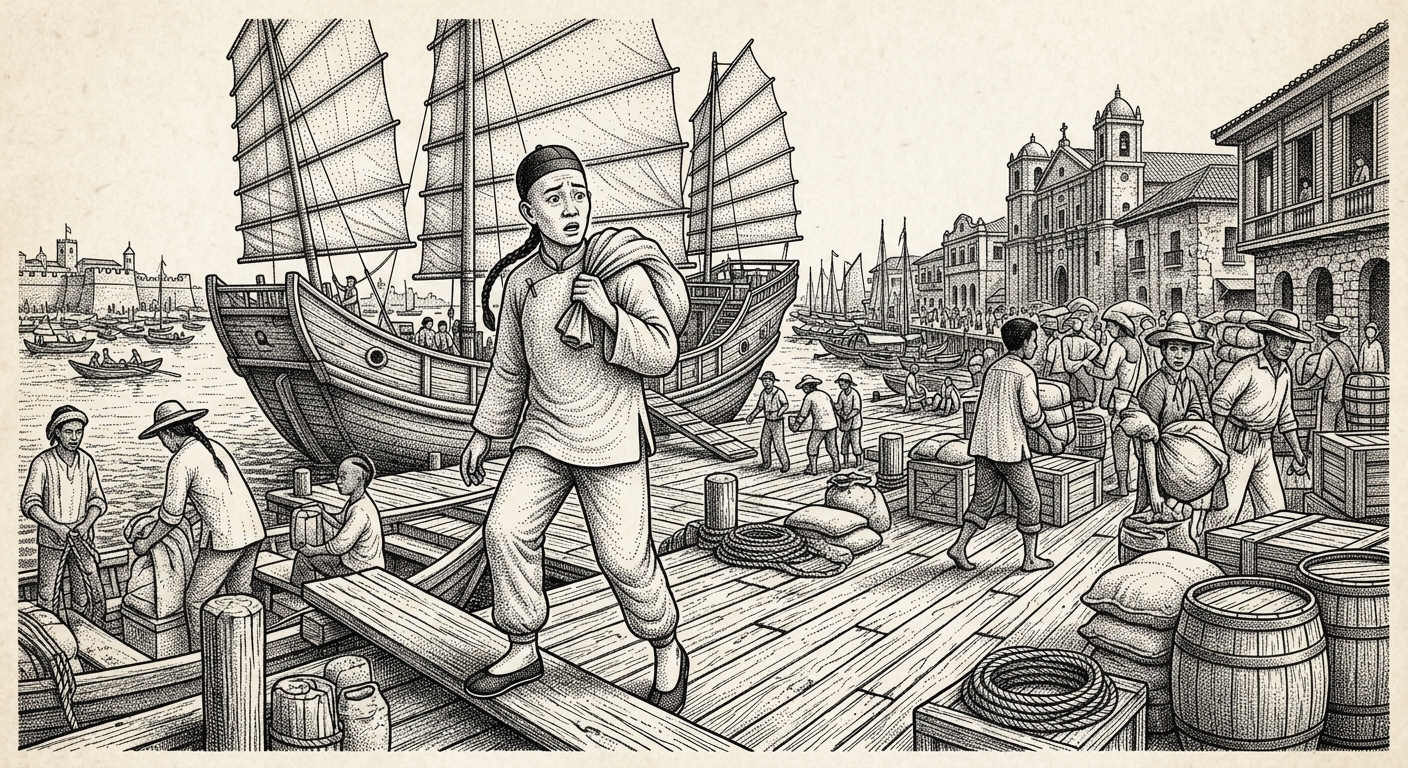
My great-grandfather left China on a junk. He rode under a tarp, with no money, no plans, and his hair still bound in the long queue of the Qing dynasty. When he stepped off in Manila he knew almost no one, and a man in that position does what he must. He set his own name aside and borrowed another.
At that age, I thought this sounded like a clerical error. So one afternoon down in the province south of Manila, while staying at my father’s eldest sister’s house, I brought it up. My father had dropped by to visit, and as we sat together in my aunt's living room, I asked him and my grandmother, in the offhand way teenagers ask things, why we didn’t just change it back.
I had never seen either of them so angry. The storm came so fast I half expected to be thrown out of the house on the spot. I had meant it as a casual question about history. They heard something else entirely. The name, it turned out, was not to be touched.
It took me years to understand. Much later, reading about narrative identity, I encountered a line between what literally happened and the story people live by, and the distinction helped. I had been after the first kind of truth. My family was guarding the second. To me the name was a detail on a document. To them it was how a young man survived, the coat he put on to build a life out of nothing. Throwing it off for the sake of authenticity would have been an insult to him. They weren't protecting a lie. They were protecting him.
The scolding didn't cure my curiosity; it only sharpened it into an obsession. A few years later, I moved north to Manila for college and majored in history—the easy choice for someone already half in love with dead emperors. I spent my days in university classrooms and quiet libraries, reading Jian Bozan and John Fairbank less as assignments than as maps, hoping to find my own small tree somewhere in that enormous forest. Qin Shi Huang, Empress Wu, Sun Yat-sen: the names piled up in my notebooks until they began to feel like relatives.
It hit me only much later that while I was buried in books in Manila, I was walking the very city where he had first arrived. But where I had academic charts, he had only the dock beneath his feet.
Years later a DNA test gave me a tidier answer. I am twenty-seven percent Chinese, with roots in the east-central and southern provinces. It is a good, clean number, and it explains nothing. It can't tell me why a man would hide under a tarp, or how the damp heat of Manila felt the day he became someone else.
Neither can a library, however quiet, or a chart, however precise. They hold facts about people. They don't give the people back.
I used to think that digging into the past was a way of reaching the truth. Now it seems more like fishing in deep water. You feel a tug now and then, but whatever is on the other end stays down there. My father and grandmother were never hiding where we came from. They were honoring the name that gave us a home. We don't choose the names we carry. The least we can do is carry them well, and be grateful to the man who chose this one.
No responses yet. Tell me what this brought back for you.