I met them all in 2004, on a vegetable farm in San Vicente.
I was to live in the employee barracks of a newspaper owned by Abed Younis, a Palestinian artist and publisher who had made a small world of his own on the island. My flight landed around three in the morning, and I stepped out into the damp stillness a foreign place has at that hour. Mr. Younis came to get me himself. He could have sent someone else, and he did not.
We drove toward San Vicente on a narrow two-lane road. Once the lights of the terminal fell behind us there was nothing on either side, and the car went uphill through the dark like a small boat, with only the headlights ahead of it. We talked a little. Outside it was entirely quiet.
I don't remember those first hours well. I was too tired. A few things stayed with me: the weight of my big red suitcase, the warmth of Mr. Younis’ welcome, and the moment it came over me where I was. He showed me to the barracks and then drove back to his own house across the vegetable field. Before he left he asked me to come to breakfast with his family.
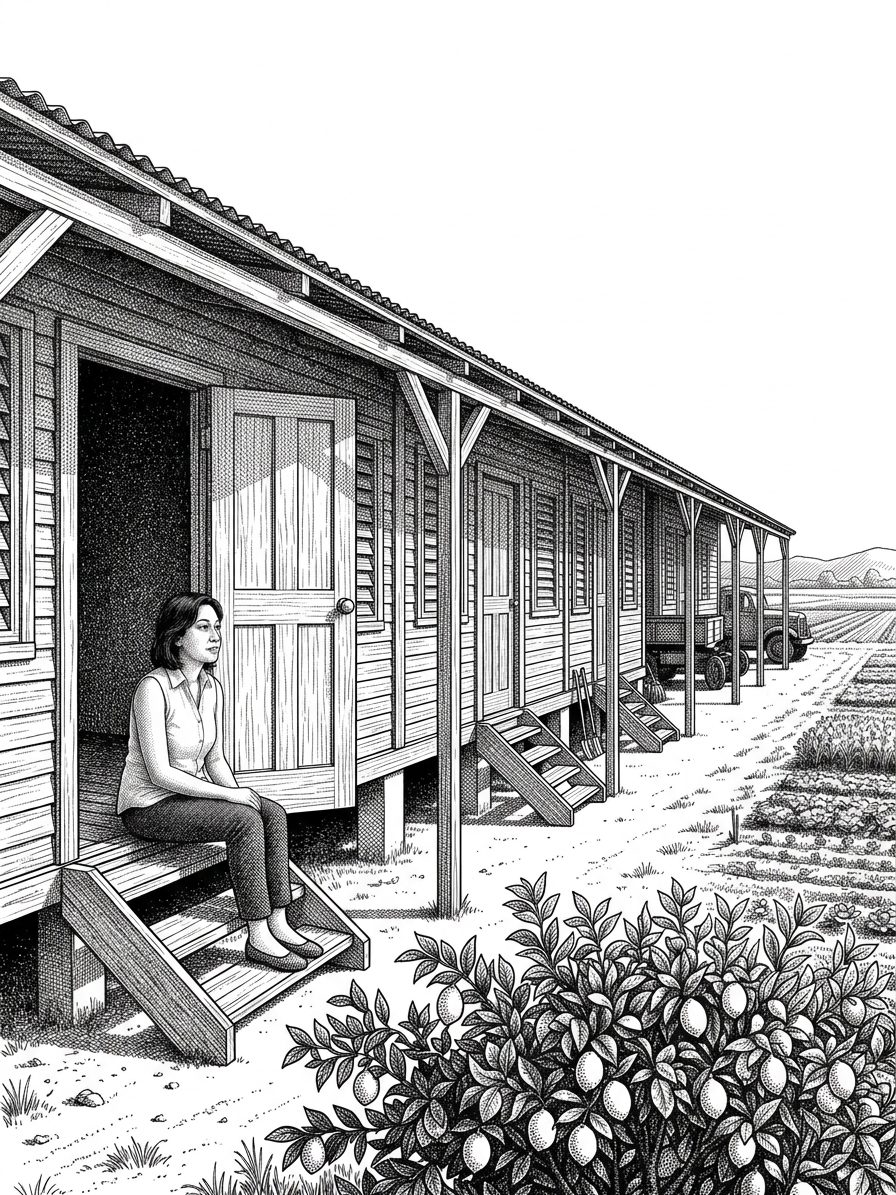
The quarters were plain and clean. Inside the front door were a small kitchen and a sink. Immediately to the left was Clarissa’s room. Adjacent to hers, across from the bathroom, was my room: a single bed made up with a green blanket, and two louvered windows, one beside the bed and one next to the head of the bed. It was room enough for a life that was starting over. The red suitcase went under the bed, and an open cubby in the wall waited for the few things I had brought.
There were still some hours of dark left for sleeping. I spent most of them crying. I thought about Manila and the life I had packed up and left: the routines I knew, the places I was comfortable in, and the faces of people I already missed.
A few hours later there was a knock at the door. It was Clarissa, my roommate, who would soon be one of my dearest friends. She took me out into the morning sun and introduced me to one colleague after another as they came out of their units along the lane.
Then I crossed the dirt path to the Younis house for breakfast and had my first lesson in Mediterranean cooking. Mr. Younis handed me warm pita and showed me how to dip it in olive oil and balsamic vinegar, with a cup of hot coffee on the side. Mrs. Paz Younis was at the table, and so was their daughter Laila, still tired from putting the advertising supplement to bed the night before. So was Mama Ligaya Davenport, the gentle Filipina who had raised most of the children in that house. Walking into that room was a little like marrying into a big family: you are handed an instant set of relatives.
Over the next day or two I met the rest. There were Mel, Jon Perez, Rick Brien, Sally, and Rose. Mel, who would also become a friend for life, came to get me for a phone call at the outdoor booth. It was a friend calling from San Antonio. Just past the booth were the barracks where Jon, Rick, and Jonathan lived. Everyone called Jonathan Tulog. They welcomed me with a bowl of munggo and fried atulay and kept me company all afternoon. They had been on the island long enough to see that I hadn't found my feet yet. It was my first time out of the country, the first time I had gone any real distance from home, and everyone around me seemed so settled that I envied them.
So I pulled myself together.
I walked back along the dirt path in my slippers and a green tie-dye daster, over the dry ground I had crossed that morning. I passed Haidee's unit, then Tita Lit's, then Sally and Rose's, then Baby and Rachel's, and came to my own door.
I sat down in the doorway with my feet on the ground. Ten or fifteen feet in front of me stood a big lemon tree, its leaves catching the sun above the vegetable farm. I took a slow breath and looked around. This is it, I thought. This is home now.
No responses yet. Tell me what this brought back for you.