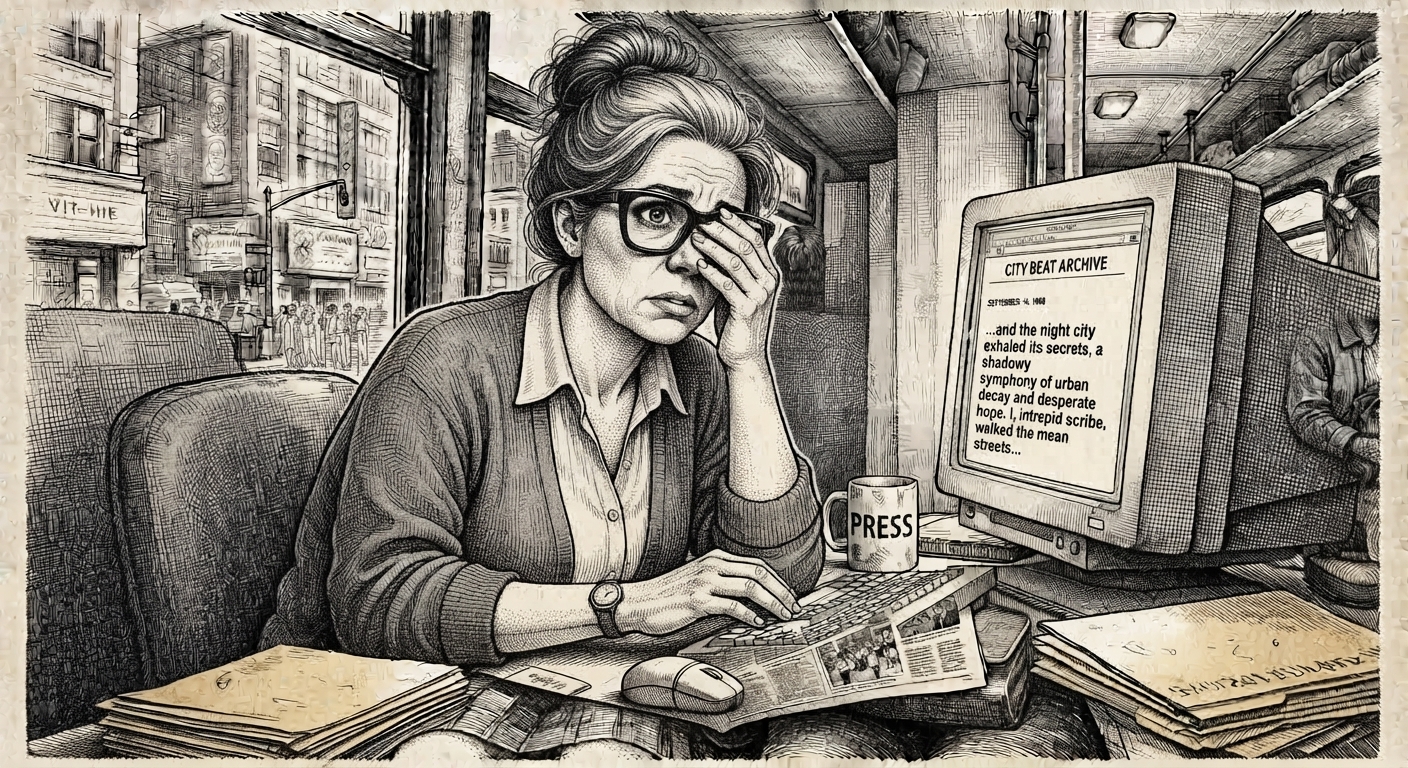
She used to believe writing should be high and lofty—distant and far removed from the dust of everyday conversation.
It started back when she was fifteen, taking a three-and-a-half-hour bus trip into the city just to read galley proofs for her high school paper. She was proud of every raw, green word she printed. She fed the habit on old copies of National Geographic rooted around in the racks at Booksale in Sampaloc and Cubao, soaking up their sweeping prose and deciding early on that grand language was the ultimate goal.
In college, the impression only deepened. Her English 101A professor spoke in towering, multi-syllable structures, with his affected nasally British-like accent. There was another instructor, who published a magazine out of San Francisco, who heaped praise for her lengthy feature on the Ossorio sugarcane dynasty. By her senior year in 1994, a rushed essay on the lives and works of Jose Rizal and Sun Yat Sen took top honors in a Metro Manila wide competition. She was convinced she had cracked the code: the bigger the canvas, the grander the voice, the smarter the writer.
So she began weighing intelligence by the pound. She dressed tiny thoughts in heavy coats and mistook plain speaking for plain thinking. It never occurred to her to doubt the system. Everyone did it, so she did too.
Then she walked into a real newsroom, red pen in hand, and the system broke down.
A newspaper is an impatient business; it wants the news down on the street before the ink dries. Yet years later on Saipan, writing for several publications under a hot island sun, she was still sweating over paragraphs, worrying about the AP Stylebook and newspaper conventions, desperate not to look foolish. She spent her days plucking out words as she pounded the keyboard, muting her own voice in the process.
Eventually she left the daily beat. She kept those old paper clippings for years, until the yellowing newsprint gave way to digital scans and she finally let the physical paper go. But every now and then, opening an old file on a screen, she’d feel a sudden wave of embarrassment—that gnawing urge to crawl into a shell or hide under a rock. There was a sprawling sentence, a stray comma, a word working far too hard to be noticed. The name at the top was familiar, but the voice belonged to a stranger.
It took more than thirty years—and a lesson from the philosopher Hans-Georg Gadamer—to understand that shame. Gadamer noted that none of us come to anything empty-handed. We carry along everything we were taught, the foolish baggage of where we began. Those big words were her armor. They were misplaced, certainly, but they were the only starting point she had, and everyone has to start somewhere.
He believed, too, that an old piece of writing isn't an artifact under glass; it’s like an old acquaintance. You don't inspect it—you sit down and have a talk with it.
So she began talking with those digitized archives. Why so many words? What was she so afraid of? Once she listened, the truth was simple enough: the girl on that long bus trip was just piling up words like a barrier to hide her insecurities.
Gadamer wrote about horizons coming together. Hers was small: an ink-stained proof, a crowded desk, and an urgent deadline. The other horizon is broader, stretched out over thirty-five years. Standing where they meet, it is easy to see that most of her fears were groundless—and that even now, the lingering desire to refine the language never really stops.
If an older, wiser writer could walk back into that newsroom today and lean over her shoulder, she wouldn't hand her a bigger dictionary or a sharper pencil. She’d advise her to take a breath, strike out the fluff, and say what happened.
She wouldn't listen, of course. I should know: that stubborn reporter was me.
I know now I don't need armor; just a stone will do the trick.
No responses yet. Tell me what this brought back for you.