This week I have been reading about another expedition to Nikumaroro, the Pacific atoll where some believe Amelia Earhart ended her days as a castaway. Next week, if all goes as planned, a team led by Richard Pettigrew of the Archaeological Legacy Institute hopes to reach the lagoon off Taraia Point and learn what a shape seen in satellite images really is. Some think it is a piece of her Electra. Others think it is a tree.
The reports sent me back to some files I keep. They weren't in yellowing folders on a desk. They were in a cloud drive, among gigabytes of clutter. I am a pack rat by temperament, and over decades in newsrooms and years on Saipan I have kept scanned records, old interviews and background briefs, many of them gathered for the 70th anniversary of the battle.
One quiet evening I opened a folder of declassified U.S. Army G-2 reports from August 1945. The scans were sharp, but the originals had been mimeographed, and the typewriter ink had bled into the cheap army paper like oil. Reading them took patience. Slowly the words came clear: Garapan Jail, American aviators, Nitta, Kinashi, Neratus.
I knew the whispers, passed along in hushed tones for nearly a century. Island elders said they had seen two white aviators in the custody of the Japanese police in Garapan before the war reached its climax. Some who heard them took the flyers for Amelia Earhart and Fred Noonan. I had always listened to the elders with respect. Now I had the Army's account in front of me.
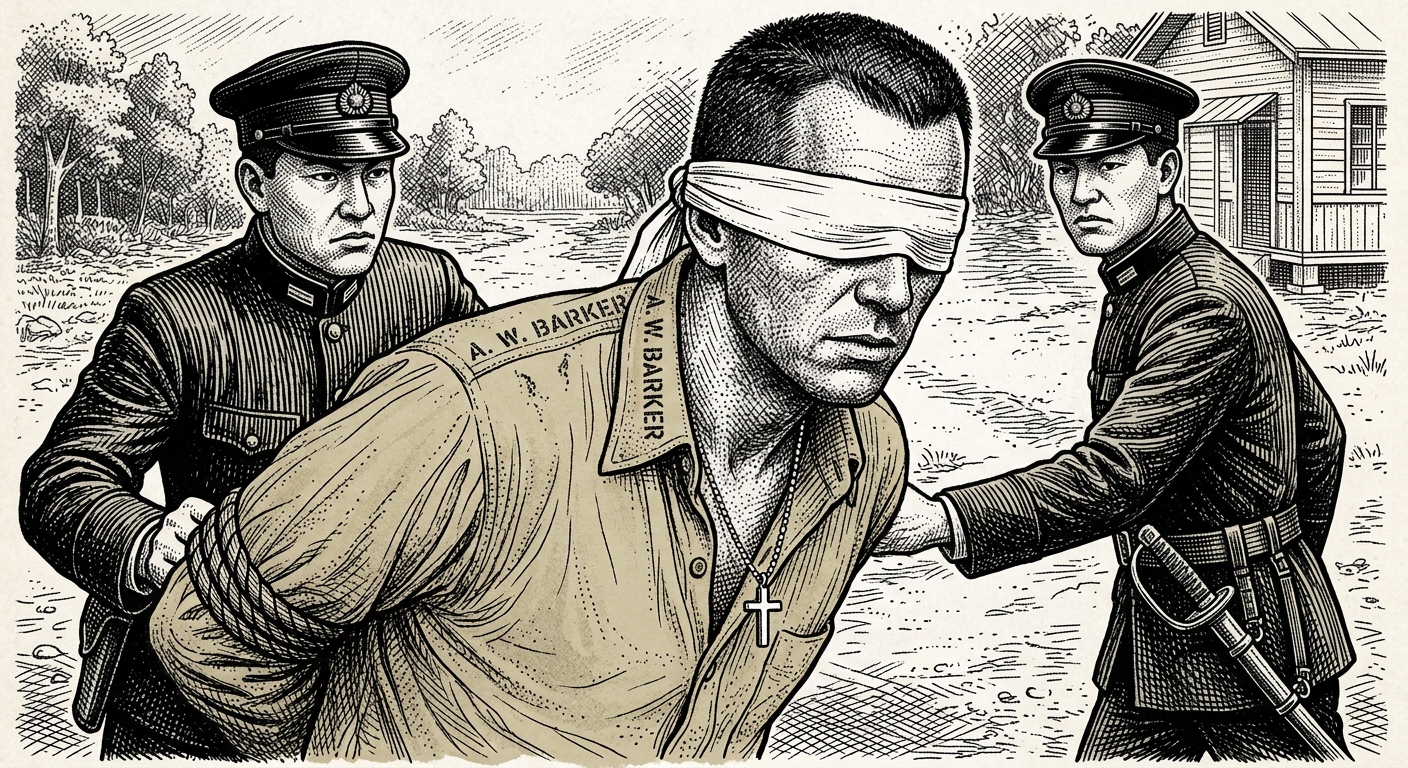
On June 3, 1944, two young Navy airmen were brought to the Garapan Jail. One was tall, with light hair. The other was shorter, his left arm torn by anti-aircraft fire. A prisoner named Neratus, a Palauan jailed for theft, felt sorry for them. When the guards turned away, he slid hardtack and bits of sugar through the bars. He remembered how angry Chief Police Officer Kinashi became when the feverish flyers asked for warm soup or soft rice.
On June 13, American planes bombed and strafed the town. The jail roof was shattered, and the shorter flyer was killed in his cell. The police ran for the hills, but first they dragged the tall flyer into the dirt behind the administration building. His hands were tied behind him. Officers Nitta and Kinashi struck him down with sabers.
Neratus was ordered to stack dry wood over the young man. He waited forty minutes in the heat for the flyer's breathing to stop. Before he lit the fire, he took a small silver cross from the airman's neck, tied two sticks together with string, laid the chain across them, and set it at the head of the pyre.
Much of this matched what the islanders had said: two American flyers in the jail, one of them wounded, the gray walls, the smoke over the brush, their deaths in Garapan in the summer of 1944 as U.S. forces closed on the shore.
Over so many years memory fades, and what remains are fragments. It moved me to find some of them confirmed on a mimeographed page, and I honor the people who kept them.
Visitors who came to hear the elders, eager to solve a persistent mystery, may have mistaken these flyers for someone else. The airmen were not trying to land on Howland Island, and their last names were not Earhart and Noonan.
No responses yet. Tell me what this brought back for you.